
A Cost-Effective Alternative to Forged Components
Centrifugally cast precipitation hardening (PH) stainless steel delivers the strength and corrosion resistance engineers expect from forged materials, without the same cost, lead time, or volume constraints.
The Real Challenge
For many applications that require PH steel, you need a material that resists corrosion or oxidation and maintains its strength at elevated temperatures. However:
- You do not have the volume to make forging cost-effective
- You need faster turnaround than forging can provide
- You cannot find alternative materials that offer the same combination of strength and corrosion resistance
- Your current supplier struggles to deliver PH steel consistently and on time
Ultimately, you are looking for a way to meet forged-level performance without the limitations of the forging process. PH steel may not be necessary for lower-strength or non-corrosive applications, where standard alloy or stainless steels can meet requirements at a lower cost.
Why Centrifugally Cast PH Steel Is the Right Choice for Steel Tubing
Centrifugal casting allows PH stainless steel to deliver the performance engineers require while removing many of the constraints tied to forging.
Here is why commonly specified grades 17-4 PH (Spuncast CB7Cu-1) and 15-5 PH (Spuncast CB7Cu-2) deliver a superior value:
1
Faster Production Times
Unlike forging, centrifugal casting does not require large production volumes or extended scheduling queues. This allows for shorter lead times and faster response to demand.
2
No High-Volume Requirement for Cost Efficiency
Forging often requires higher volumes to justify cost. Centrifugal casting enables cost-effective production at lower quantities, making it ideal for specialized or limited-run applications.
3
Strength, Corrosion Resistance, and How the Process Delivers It
In centrifugal casting, molten metal is spun at very high speeds, forcing it against the mold wall to create a dense, uniform structure with consistent chemistry. This process, combined with heat treatment, achieves mechanical performance that rivals forged components in many applications.
While forging can provide finer grain structure in highly critical applications, many PH steel components do not require that level of refinement to meet performance requirements.
Value-Added Capabilities for PH Steel Components

Centrifugally cast PH steel can be a cost-effective alternative, but results depend on choosing a foundry with the manufacturing capability to deliver the complete, finished component.
Metallurgical Expertise
PH stainless steels are not commodity materials. They require controlled chemistry and disciplined processing to achieve the desired precipitation hardening response and consistent performance.
- Controls melt chemistry for 17-4 PH (Spuncast CB7Cu-1) and 15-5 PH (Spuncast CB7Cu-2)
- Verifies mechanical properties to specification
- Optimizes microstructure for strength, toughness, and corrosion resistance
1,000+ Permanent Molds
Dimensional repeatability and lead time stability begin with tooling depth.
- Broad OD coverage without new tooling investment
- Faster startup for repeat programs
- Improved consistency across long production runs
Metal Testing, Traceability, and Certification
Every casting is verified and documented for compliance and repeatability.
- In-house chemical and mechanical testing
- Produced to applicable ASTM standards
- Unique heat number for full traceability
Precision Machining
Integrated machining ensures final tolerances align with casting and heat treatment. High material yield from centrifugal casting (often 70–90% usable) reduces scrap and improves machining efficiency.
- Turning, boring, and honing for tubular geometries
- Tight ID and OD tolerances
- Near-net hollow shape reduces machining waste versus solid forms
Heat Treating
Proper heat treatment is critical to PH steel performance, driving the precipitation hardening process that delivers strength.
- Controls final strength and hardness through specified aging conditions (e.g., H900, H1025)
- Supports consistent through-wall mechanical properties
- Reduces risk of distortion and variability
Spuncast Shipping Services
Spuncast’s integrated shipping services reduce complexity, lower costs, and ensure your parts arrive ready for use.
- 95%+ on-time delivery to keep schedules on track
- Freight consolidation to reduce shipping costs
- Coordinated logistics from melt through final delivery
- Protective packaging to prevent damage in transit
PH Steel Capabilities and Grades
Looking for 17-4 PH or 15-5 PH Stainless Steel?
Spuncast produces centrifugal cast equivalents to many precipitation-hardening stainless steel alloys commonly manufactured using wrought, forged, or other casting methods.
- 17-4 PH Stainless Steel: Spuncast produces an equivalent centrifugal cast alloy called CB7Cu-1, which offers a similar combination of high strength, toughness, and corrosion resistance after heat treatment.
- 15-5 PH Stainless Steel: Spuncast produces an equivalent centrifugal cast alloy called CB7Cu-2, designed for applications requiring properties similar to 15-5 PH stainless steel.
Custom tube sizes, wall thicknesses, and centrifugal cast components can be produced to meet your exact specifications. Spuncast centrifugal cast PH steels equates to the following industry standards:
| Industry Standards* | ||||
|---|---|---|---|---|
| ASTM Standard | A 747 AMS 5398 | A 747 AMS 5348 |
||
| UNS | J92180 | J92110 | ||
| Similar DIN | 1.45 | |||
| Spuncast Alloys | CB7Cu-1 | CB7Cu-2 | ||
| Similar Alloy | 17-4PH | 15-5PH | ||
| Chemical Specifications | ||||
| Carbon max | 0.07 | 0.07 | ||
| Manganese max | 0.70 | 0.70 | ||
| Silicon max | 1.00 | 1.00 | ||
| Phosphorus max | 0.035 | 0.035 | ||
| Sulfur max | 0.035 | 0.03 | ||
| Chromium | 15.50- 17.70 | 14.00-15.50 | ||
| Nickel | 3.60-4.60 | 4.50-5.50 | ||
| Mechanical Properties | ||||
| Tensile (min) - KSI (MPa) | 170(1170) | 145(1000) | 125(860) | Heat treatments and physical properties same as CB7Cu-1 |
| Yield (min) - KSI (MPa) | 145(1000) | |||
| Elongation (2" min) | 5% | 9% | 10% | |
| Brinell Hardness (10mm - 3000Kg -) Typical Values | 375 min | 277 min | 269 min | |
| Density lbs/in | 0.28 | |||
| Heat Treatment | (H-900) | (H1075) | (H1150) | |
The Big Question
How Does Centrifugal Casting Reduce Total Cost of Ownership for PH Steel?
PH stainless may carry a higher base material cost than standard alloys, but total cost is driven by efficiency, yield, and lifecycle performance.
- Lower material consumption and component weight with PH steel’s higher strength
- Cut scrap and machining costs through 70–90% usable material yield from centrifugal casting
- Streamline production and shorten lead times with integrated casting, heat treating, and machining
- Protect schedules from disruption through reliable delivery performance and domestic sourcing
When properly engineered, the combined material and manufacturing advantages of centrifugally cast PH steel typically outweigh the base alloy cost.
Get pricing tailored to your specific HSLA steel requirements.
Who We Help
Industries
Centrifugally cast PH stainless steel is used in industries where performance and reliability are critical:
| Industry | Applications |
|---|---|
| Aerospace and defense | Bushings, landing gear components, high-strength shafts |
| Oil and gas | Valves, pressure components, rotating equipment |
| Power generation | Turbine shafts, rotating equipment |
| Marine and offshore | Shafts, corrosion-resistant structural components |
| Industrial processing | Valves, pressure components, general high-strength parts |
People
| Role | How You Benefit from Our Approach |
|---|---|
| Design and manufacturing engineers | Specify high-performance PH steel components with confidence in strength, corrosion resistance, and manufacturability |
| Procurement teams | Identify cost-effective alternatives to forging with improved lead times and flexible volumes |
| OEMs and Tier 1 suppliers | Receive repeatable, certified components with consistent quality and performance |
| Quality and validation teams | Gain full traceability, documentation, and confidence in material and process consistency |
Why Spuncast
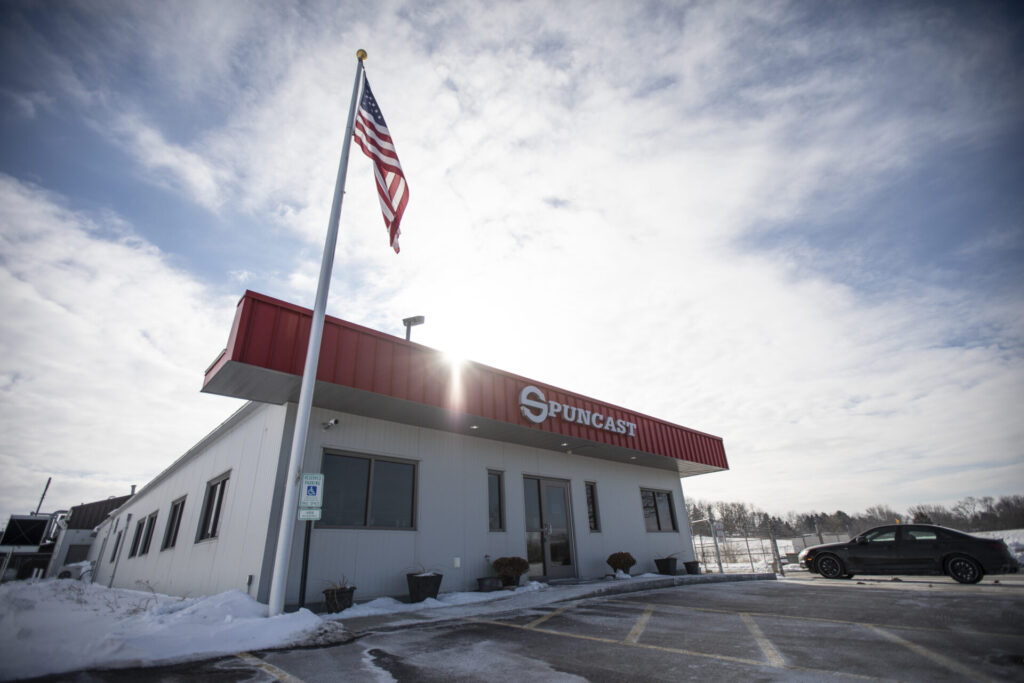
Spuncast combines metallurgical expertise with a specialized centrifugal casting process to deliver reliable PH stainless steel components.
- 50+ years of centrifugal casting expertise
- 200+ standard and custom alloy options
- 1,000+ permanent molds
- 95%+ domestic material sourcing
- 30+ certified material suppliers
- In-house metallurgical support
- Integrated testing, heat treating, machining, and shipping
- ISO 9001 certified quality system
- Lifetime product warranty
- Employee-owned accountability through ESOP ownership
When performance matters but forging is not the right fit, Spuncast provides a proven, fully verified alternative for PH stainless steel components.
Get pricing tailored to your specific HSLA steel requirements.
PH Steel FAQs
PH Steel vs Forged Steel
When should you choose centrifugally cast PH steel instead of a forged component?
The key decision usually comes down to cost, lead time, and volume. Forged components are often assumed to have higher strength, but centrifugally cast PH steel can meet the same tensile, yield, and elongation requirements in many cases. If your application doesn’t require the highest level of grain refinement—and you need faster turnaround or lower cost—centrifugal casting becomes a strong alternative.
Can centrifugally cast PH steel match forged material performance?
Yes—in many cases, it can meet the same mechanical property requirements. Through centrifugal casting, the metal is densified under high G-forces, allowing the material to achieve properties comparable to forged specifications, even though the grain structure is different.
Where does forged PH steel still have an advantage?
Forging still has an edge in grain refinement, which can matter in highly critical applications—especially where maximum strength, wear resistance, or safety is non-negotiable. In those cases, forged material may still be the preferred option.
When to Use PH Steel
Why do engineers choose precipitation hardening stainless steel?
PH steel is selected when an application requires a combination of high strength, corrosion resistance, and dimensional stability—especially in thin-wall or high-stress environments where other materials fall short.
What types of applications are best suited for PH steel?
PH steel is commonly used in aerospace, defense, marine, and energy applications where components must maintain strength and resist corrosion under demanding conditions—such as turbine shafts, bushings, and high-stress rotating components.
Material Selection and Comparisons
When does PH steel outperform other materials?
PH steel stands out when you need all three of the following at once:
- High strength
- Corrosion resistance
- Ability to hold shape in thin-wall designs
Materials like duplex stainless may offer better corrosion resistance, and low alloy steels may offer strength—but PH steel is often the best balance of both.
When is PH steel not the right choice?
PH steel may not be necessary when:
- Corrosion resistance isn’t required (a lower-cost alloy steel may work)
- Strength requirements are lower (standard stainless may suffice)
- Maximum corrosion resistance is the priority (duplex stainless may be better)
In those cases, PH steel can be more material than the application actually needs.
Which PH steel grades are most commonly used?
Most applications rely on 17-4 PH and 15-5 PH. There are only a few widely used grades in this category, and they are chemically and mechanically very similar, with selection often coming down to engineer preference or specific design requirements rather than major performance differences.
Process and Spuncast Advantage
Why is centrifugal casting a strong fit for PH steel?
Centrifugal casting allows PH steel to achieve high density and strong mechanical properties by forming the material under extreme rotational force. This process enables the material to perform similarly to forged products—without the same cost or lead time constraints.
What makes PH steel a good candidate for heat treatment?
PH steel is designed to gain strength through precipitation hardening, where heat treatment causes elements like copper to form a structured matrix within the metal. This process significantly increases strength and hardness while maintaining corrosion resistance.
Cost and Value
How does PH steel compare in lifecycle cost to forged components?
Lifecycle performance is typically very similar between forged and centrifugally cast PH steel. The main difference comes in upfront cost and production flexibility, where casting often has the advantage.