
Every steel tube manufacturer claims to provide a superior product with reliable, consistent performance. But what metrics can you use to truly evaluate the foundry’s overall quality and trustworthiness as a partner? One number that should be at the top of your list is scrap rate.
A foundry’s scrap rate is one of the best indicators of future performance. That’s because scrap rate not only is a measure of defects, but it gives you a sense of the foundry’s operational efficiency, keeping materials costs low, and on-time product delivery.
All of this ties into not only producing a quality product, but also delivering the lowest total cost of ownership. Ultimately, it indicates that you’re working with a partner you can count on, delivery after delivery.
In this post, we’ll break down how scrap rate is a measurement of manufacturing consistency. We’ll be referencing some quality studies on the impact of scrap rate, along with the expertise of Spuncast’s Vice President of Operations, Rob Kluz.

Let’s dive in!
What is a foundry’s scrap rate and what is its biggest impact?
When it comes to stainless steel tubing, scrap rate is typically viewed as the result of obvious casting defects. These defects may or may not be viewable to the naked eye, and it’s usually expressed as a percentage of cast product that fails to meet the tubing specifications.
“We take all the pounds used to produce the product, and then subtract whatever was unusable,” said Rob. “The defective yield is what we use to compute the scrap rate.”
That’s pretty straightforward, but the impact extends beyond just the unused raw material.
Scrap forces a foundry to repeat work that’s already been done once.

“When you have a low internal scrap rate,” Rob explains, “You don’t have to start over the process, which makes the delivery more repeatable.” This is critical, because repeating the production of tubing means you have to pay for more:
- Material
- Labor
- Machine time
- Furnace capacity
- Scheduling
So how do those potential foundry impacts affect you, as a customer?
- Higher prices, because the foundry has to offset revenue losses.
- Delayed deliveries or missed timelines, because a foundry has less capacity for the same amount of orders.
- Increased risk of defects, because the more defects, the greater the chance one will go undetected.
A high scrap rate isn’t good for you, and it’s not good for the manufacturer either. In a comparable manufacturing industry (high-volume plastics), scrap cost accounted for 4-7% loss of revenue. Which is why Rob and his team put such a premium on maintaining a scrap rate that’s lower than the industry standard.
How a low scrap rate translates into a quality foundry

Defects cost foundries, not only in additional labor, material and machining costs, but also because it removes “hidden capacity.”
In manufacturing, every percentage point of scrap removes its “hidden capacity.” This is the amount of product a foundry would be able to produce if it was more efficient.
For example, a foundry with a 10% scrap rate would be able to produce 100 castings, but only ship 90, with the rest falling victim to defects. However, a foundry with a 3% scrap rate, producing the same 100 castings, would be able to ship 97. That’s a production increase of 8%.
That’s why we work so hard to ensure repeatability and consistency, so we can reduce costs and unlock that hidden capacity.
That requires quality performance throughout the foundry, from the initial order through the final machining. Here are just a few key areas of focus:
Understand the application: When Spuncast receives an order, Rob notes they work diligently to understand the goal of the customer. “We don’t just take a drawing at face value,” he said. “We consider the applications and establish the critical requirements.”
Engineer the process: Based on the specifications, our engineers and metallurgists will establish the correct alloys, heat treatment and machining required to meet the requirements.
Validate the results: Once the tubing is complete, Spuncast uses two methodologies to check for defects:
- Visual inspection, in which operators manually review the tubing for any defects.
- Penetrant and magparticle inspection, which are two types of non-visual inspections. Penetrant inspection uses a dye to detect any types of surface defects, and magparticle uses a magnetized process to check for subsurface cracks.
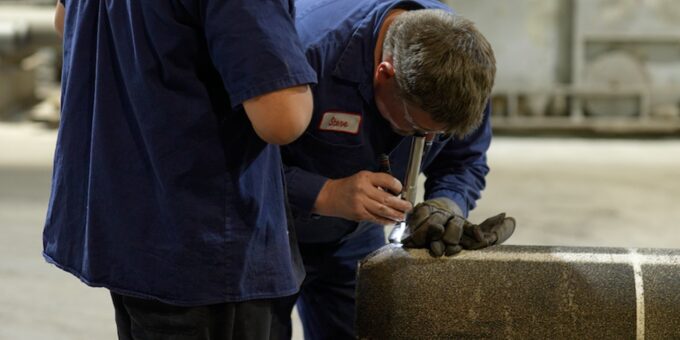
All of these steps ultimately result in a more consistent product. “A more consistent product will machine better,” he said. It also provides more consistent machining performance from one casting to the next.
What should you look for when evaluating scrap rate?
You can evaluate any foundry for not only its scrap rate, but for the processes that impact overall quality. Here are some key questions you should ask:
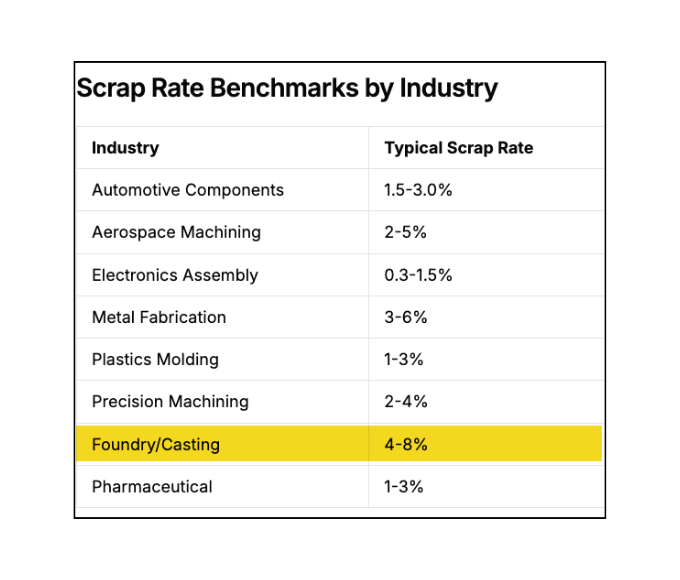
Does the foundry publish its scrap rate? Spuncast’s scrap rate is below 3.5%, and we proudly publish that number on our website. Make sure any foundry you work with can produce that number without hesitation, and avoid anyone above the industry average of 4-8% (Source).
Do they employ metallurgists? Make sure your foundry has a metallurgist and engineer team on staff, and that they are working with you on understanding your goal and your critical requirements.
Do they offer integrated machining and heat treating? Heat treating and CNC machining should be table stakes for ensuring dimensional consistency and identifying issues before shipping. Give bonus points to the foundry that features these value-adds in-house.
Do they explain how they investigate defects? When defects occur, does the foundry perform root-cause analysis to understand why they happened and implement corrective actions? A foundry that learns from failures is far less likely to repeat them.
Do they perform in-house testing? Beyond testing for defects, does the foundry provide quality verification and traceability of the part. This includes verifying the chemistry, testing mechanical properties, and ensuring the part meets specifications before shipment.
Do they maintain third-party certifications? Internal quality processes are important, but independent verification provides another level of confidence. Look for certifications such as ISO 9001, along with any industry-specific certifications that apply to your application.
Scrap rate shows you the big picture
Quality is not always easy to define in a world that relies on data. In our endless quest for the metrics that make a difference, we need numbers we can trust, ones that tell the story of a foundry partner you can rely on.
That’s why scrap rate is such an invaluable metric. Its implications extend far beyond wasted material costs. It reflects repeatable processes, quality systems, and a consistent stainless steel tubing product you can trust.
Scrap rate shouldn’t be the lone number you focus on when you choose a foundry partner, but it should be one of the first. It offers valuable insight into the manufacturing quality behind every tube you receive.
